We are only able to ship to Guernsey
Why Does an Eco Washing Machine Cycle Take Longer?

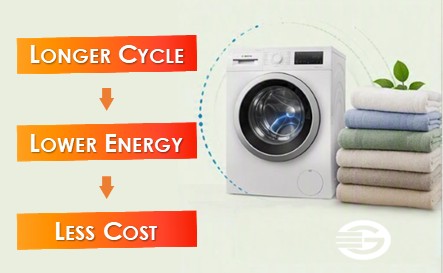
We sometimes hear comments from customers that their new washing machine takes longer than their old one to complete a standard wash cycle. This can understandably lead to concerns that the appliance is using more electricity, but the opposite is often true. Longer Eco programmes give the machine more time to clean effectively while heating less water and operating at lower temperatures. Here, we explain how this works and explore some of the other energy-saving features found in modern washing machines.
Why can an energy-efficient wash take longer?
When selecting a washing-machine programme, it is natural to assume that the shortest cycle will use the least electricity. Surprisingly, this is often not the case.
A significant proportion of the energy used by a washing machine goes into heating water. Eco programmes reduce energy use by heating less water, operating at lower temperatures, and allowing more time for soaking, detergent action, and controlled drum movements.
A useful comparison is economical driving. Travelling steadily may take longer than accelerating hard, but it can use less energy overall. In the same way, programme duration alone does not tell you how much electricity a washing machine is using.
What does Eco 40-60 mean?
Eco 40-60 is designed for normally soiled cotton laundry labelled as washable at either 40°C or 60°C. Suitable items carrying these care temperatures can be washed together in the same cycle.
The name does not necessarily mean that the water remains at exactly 40°C or 60°C throughout the wash. The machine automatically controls the temperature to balance cleaning performance with efficient energy and water use.
Eco 40-60 is also the programme used to measure the energy and water consumption shown on a washing machine’s energy label. It is generally the appropriate choice for normally soiled everyday cotton laundry when saving energy is more important than completing the wash quickly.
Why can a quick wash use more energy?
A quick programme has less time to complete the job. Depending on the appliance and selected cycle, it may compensate through a higher temperature or more intensive washing action.
Quick programmes are designed mainly for convenience and are usually intended for smaller or lightly soiled loads. They remain useful when time matters, but speed should not automatically be confused with efficiency.
Other energy-saving washing-machine features
Load sensing: Technologies such as AEG ProSense, Bosch Active Water Plus, and load-detection systems from Hotpoint and Haier assess the load and adjust water, energy, and programme time. This helps avoid treating every wash as a full load.
Lower-temperature cleaning: Modern detergents and washing technologies can clean many everyday loads effectively at lower temperatures. Hotpoint ActiveCare, for example, premixes water and detergent to help the cleaning solution penetrate fabrics at low temperatures.
Automatic detergent dosing: These systems calculate and dispense detergent according to factors such as load size and fabric type. Accurate dosing helps reduce detergent waste, excess foam, and unnecessary rinsing.
Efficient motors and spinning: Brushless inverter motors are designed to reduce friction and energy losses. Where suitable for the fabric, a higher spin speed can also remove more water and reduce the energy subsequently needed for tumble drying.
Simple ways to improve efficiency
- Choose Eco 40-60 for suitable, normally soiled cotton loads when time allows.
- Use quick programmes only when the load and level of soiling are appropriate.
- Wait for a fuller load where practical, but do not overload the drum.
- Select a lower temperature when suitable for the fabric and level of soiling.
- Measure detergent carefully, or use automatic dosing when available.
- Keep the detergent drawer, filter, drum, and door seal clean.
- Check the energy label and user manual, as programmes vary between models.
Make use of Super Economy 12
One of the easiest ways to reduce the cost of doing your laundry is to make use of the low-rate periods available on the Super Economy 12 tariff. Most modern washing machines include a delay-start function, allowing you to load the machine and schedule the programme to begin during your low-rate period.
Guernsey Electricity recommends using appliances between 11pm and 5am where practical, although customers should check the exact low-rate times shown on their electricity bill. Combining an efficient Eco programme with low-rate electricity can considerably reduce the cost of each wash without compromising cleaning performance.
Find out more about Guernsey Electricity tariffs.
Choosing the right appliance
When comparing washing machines, look beyond programme duration. Consider the energy rating, stated electricity and water consumption, capacity, available programmes, spin performance, and how well the appliance suits your household.
Visit the Guernsey Electricity shop on The Bridge or browse our range online. Our retail team can help you compare models and choose an efficient washing machine that suits your home, lifestyle, and budget.
See the full range of energy-efficient washing machines that we have in-stock now.

Related Posts
Choosing an energy-efficient washing machine
08/08/2025| Posted in Laundry| 389

New year resolutions
04/01/2026| 257

Making a sound difference
16/05/2024

IPX waterproof ratings explained
06/06/2024

Shark floorcare now at Guernsey Electricity
23/11/2024


Christmas opening times 2024
14/12/2024

What Is True RGB, and Why Does It Matter?
14/09/2026

New year resolutions
04/01/2026

Choosing an energy-efficient washing machine
08/08/2025